
Winter cycling in the Pyrenees: what to wear, lights, and where to ride
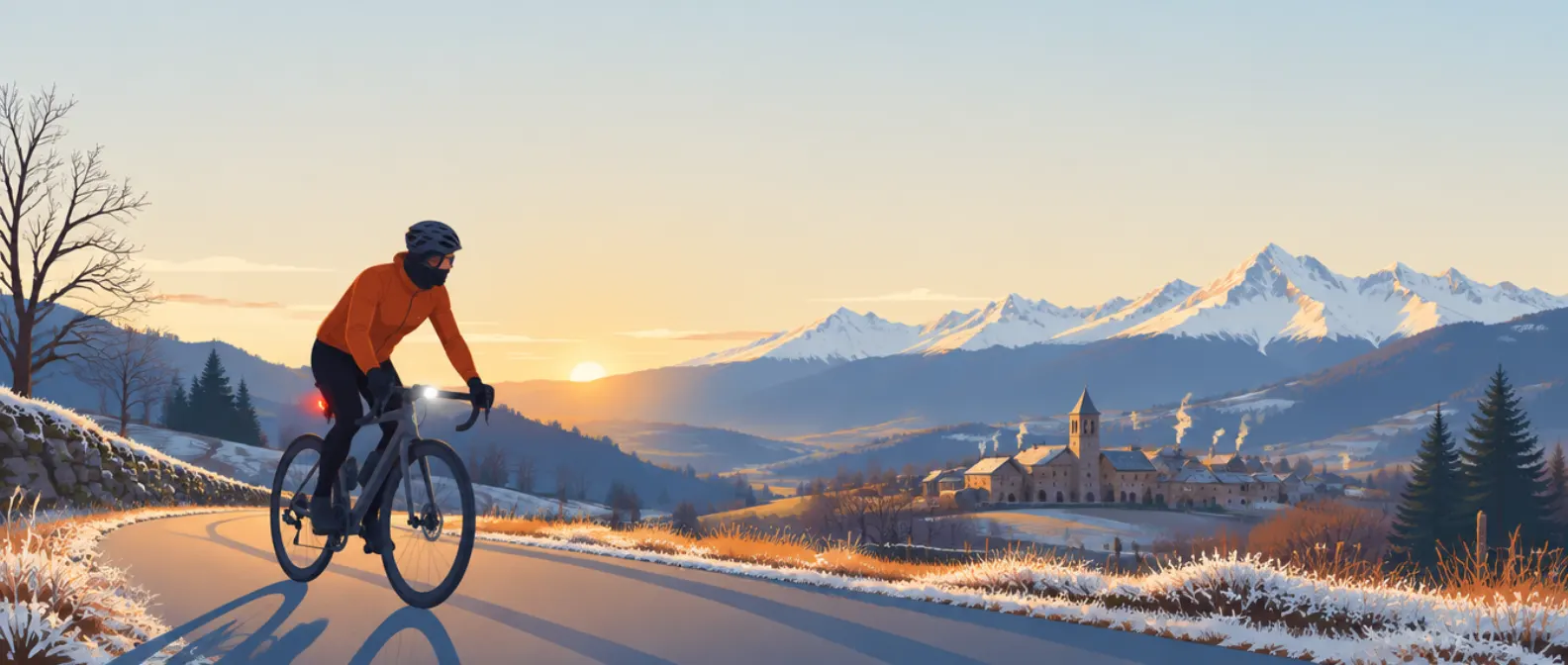
The giants close, but the season doesn't stop: the foothill climbs stay open almost all winter, the roads are empty and the low December light is as good as July's. What changes is the margin for error. Three things matter: staying warm without getting soaked, being seen, and knowing where to ride.
Dressing: three layers, no more
 The winter trap isn't the cold, it's sweat: you climb drenched, you descend wet, and that's when you
freeze. The system that works comes in three layers:
The winter trap isn't the cold, it's sweat: you climb drenched, you descend wet, and that's when you
freeze. The system that works comes in three layers:
- Next to the skin: a technical base layer (synthetic or merino), never cotton, which holds moisture and chills you as soon as you stop;
- In the middle: a long-sleeve thermal jersey, the insulation;
- Outside: a windproof jacket (a softshell when it's really cold) that stops the wind without turning your chest into a sauna.
The simple rule: feel a little cold for the first ten minutes. If you're cosy leaving the house, you'll be too hot at the foot of the first climb.
Hands and feet, where winter is won or lost
Your torso warms itself while pedalling; your hands and feet don't. They are what turns a ride into an ordeal:
- Gloves: windproof winter gloves, plus a thin pair in your pocket for the climb, where thick gloves make you sweat;
- Feet: overshoes (neoprene below 8–10 °C) and wool socks that aren't too tight: a shoe that squeezes the foot cuts circulation and gets cold faster;
- Head and neck: a skull cap or headband for the ears, and a neck gaiter you pull up over your nose on the descent.
What to wear at which temperature?
- Above 15 °C: summer kit, arm warmers and a gilet in the pocket for the descent;
- 10 to 15 °C: long-sleeve jersey, three-quarter tights or leg warmers, windproof gilet;
- 5 to 10 °C: the three layers, full tights, long gloves, overshoes;
- 0 to 5 °C: softshell, winter gloves, skull cap, neck gaiter, and a shorter ride;
- Below 0 °C: black ice becomes the real question, long before the cold (see below).
 These thresholds apply at the highest point of the ride, not at your front door: air loses about
0.6 °C every 100 m, so a summit 800 m above the valley is often 5 °C colder. The summit forecast is on every
climb page.
These thresholds apply at the highest point of the ride, not at your front door: air loses about
0.6 °C every 100 m, so a summit 800 m above the valley is often 5 °C colder. The summit forecast is on every
climb page.
The descent: where the real cold is
Climbing, you produce heat; descending, you don't, and the wind strips it away. At 5 °C, descending at 50 km/h feels like air around -1 °C on your skin. Before you tip over the top: zip up, put on the thick gloves, pull up the gaiter, and if you've sweated, change a layer at the summit (a dry jersey in the back pocket is 150 g that changes everything). Descend more slowly than in summer: numb fingers brake less well.
Lights: what French law requires
As soon as night falls or visibility drops (fog, rain, tunnel), the French highway code requires on a bike:
- a white or yellow front light and a red rear light;
- reflectors: red at the rear, white at the front, orange on the wheels and pedals;
- outside built-up areas, a reflective vest (the yellow vest) worn by the rider.
 And a helmet, of course, even though the law only requires one for children under 12.
Lights: what actually keeps you safe
The law sets the minimum. For winter riding, aim higher:
- Run your rear light all day, flashing: under a low winter sky an unlit rider disappears into the background, and daytime is when traffic is heaviest;
- A real headlight if you might get home after dark: a "be seen" light won't show you the gravel on a descent. Count on at least 400 lumens, aimed low enough not to dazzle;
- Check battery life: cold drains batteries far faster than advertised. Charge before every ride and carry a small backup light;
- Movement gets noticed: reflective bands on your ankles or overshoes stand out from much further away than a static back.
And check sunset time: around 5:30 pm in Pau in December. A puncture at 4:30 pm at the top of a climb and you're descending in the dark.
Black ice, salt and gravel
 Winter's number one danger is the patch of ice you can't see:
- Shaded spots: north faces, woods, the exit of a bend in the shadow of a rock. A road dry in the sun can be frozen ten metres further on;
- Run-off: water crossing the road in the afternoon refreezes as soon as the sun drops behind the ridge;
- Mornings: after a night below 0 °C, wait until the road has had some sun. Leaving at 11 am rather than 8 am often means 5 °C more and no ice;
- Salt and grit from snow clearing linger in the bends: brake early, in a straight line, and rinse the bike afterwards (salt eats chains and cassettes).
Kit-wise: 28 to 32 mm tyres run a little softer than in summer grip better on a cold, damp road, and mudguards spare you the jet of icy water up your back.
Where to ride in winter?
The big climbs are closed from November to May, and a closed road is closed for good reason: snow, rockfall and avalanches, even when the bottom looks dry. That leaves the foothill climbs, open almost all year:
- Basque Country: Saint-Ignace, Ibardin, Osquich, Ispéguy, with the mildness of the ocean;
- Béarn: Ichère and Porteigt in the Aspe and Ossau valleys;
- Bigorre and Comminges: Coupe, Palomières, Ares;
- Ariège and Catalonia: Marrous above Foix, Força Real, often sunny when everything else is grey.
Before you go, check the road status on the climb page and the latest road news on the
map: the departmental road services report closures and snowy roads there. And if the
snow-clearing calendar is already on your mind, that's a
good sign: spring is built in winter.
Eat and drink, even when you're not thirsty
Cold kills thirst, not your needs: you lose as much water as in summer, through breathing and under the layers. Drink every 20 minutes, and think of a flask of hot tea in the bottle cage. Your body also burns more energy keeping warm: eat regularly, before you're hungry. And carry what you need to fix things: changing a tube with frozen fingers takes twice as long, one more reason to leave early and be home before dark.